Wednesday, January 14, 2009

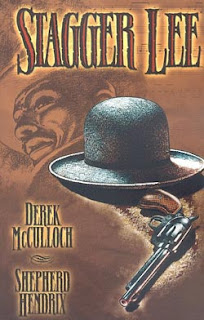
Stagger Lee by Derek McCulloch and Shepherd Hendrix

stagger lee by derek mcculloch and shepherd hendrix.

This year is off to a great start, comicswise. A great start. First The Arrival and now Stagger Lee.

In case you were as poorly educated as myself, Stagger Lee is a legendary American figure who killed a man over a hat. McCulloch did a heap of research into the origins of the legend and the thousand songs it spawned and put together this compelling fictionalized account that's part cultural history, part journey to old-timey St. Louis, part novel. It feels so true that the notes at the end that list the corrects and incorrects and whoknows are less believable --- it's hard to accept that this account is not a perfect reflection of life actual.

Meanwhile, the brown and brown illustrations of Shepherd Hendrix are great. I do have complaints (in extreme closeup, everyone looks the same, for instance), but generally, his work is great. And since the title character and the man he kills change race and bodytype with some regularity, it's impressive that it's so easy for me the reader to keep them straight.

art by shepherd hendrix

Stag Lee is always in scribbles and Billy wears crosshatch. Very nice.

In addition to the Stack-o-Lee story itself, the narrative weaves in a couple other songs that have their genesis in the era as well as some other interesting tales like that of Joseph Folk and Colonel Ed Butler.

Great read.

Sunday, January 11, 2009

Goddam Batman and Robin, the Boy Wonder

Good things about All-Star Batman and Robin, the Boy Wonder Volume 1:
  • Jim Lee's art is pretty (even if not particularly suited to the story).
  • The first time Batman said "I'm the goddam Batman," it was funny (even if less so each of the 47 times it was repeated thereafter).
  • It was amusing to see Batman and Robin exploit Green Lantern's weakness by painting themselves and the room they were in completely yellow (even if Frank Miller's obvious contempt for Green Lantern and anyone else who isn't Batman got really tiring after a while).
  • Miller's take on Robin--that Batman had been eyeing Dick Grayson as a future recruit for quite some time and the murder of the boys' parents simply moved his timetable forward by several years--makes more sense than the traditional take because honestly, Batman can't make every orphan he comes across his partner (even if Miller's take on the Batman/Robin relationship is otherwise disturbing and creepy).
And, yeah, I think that's about it.

Miller's The Dark Knight Returns in 1986 was revolutionary because it did something that hadn't been done before with Batman or with comics. His Batman: Year One in 1987 was great because it made Batman real in a way that previous stories had not. With those two stories Miller established who Batman would be for the next two decades, in comics and elsewhere.

With Miller's 2001 sequel The Dark Knight Strikes Again and now this Dark Knight prequel/Year One sequel, he's simply gone off the deep end. Batman is no longer a grim and gritty, somewhat obsessed crimefighter. He's a psychopath and a sadist. Yes, perhaps in the real world any person who dresses up like a bat to fight crime would have to be like this, but if I'm willing to beleive that a man drives around in a car that transforms first into a plane and then into a submarine, I'm willing to believe that that man just might have some shred of human decency.

If not for the almost universally poor reception, I'd fear that this is what Batman will look like for the next twenty years. DC will continue to publish All-Star Batman and Robin so long as Miller and Lee's names continue to make it their top-selling title (and I suspect a good portion of those sales are from people like me who are just curious to see the train wreck everyone's talking about), but hopefully they recognize it's not the quality of the story or the likeability of the characters that's bringing in all that money.

Thursday, January 8, 2009

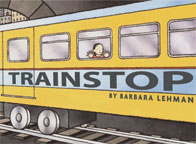
Trainstop by Barbara Lehman

.

Speaking of wordless comics and speaking of picture books in comic form, may I recommend this fun little book?

Trainstop by Barbara Lehman

The Arrival by Shaun Tan

.

The Arrival by Shaun TanNever have I so clearly understood the feelings of strangeness and desperate loneliness inherent in immigration as when reading this beautiful book. Tan's sepia-toned faux photographs et in, idk, 1890s Shangri-La?, bring it home as no other story of immigration in any other medium has ever managed before -- at least for me personally. Because no matter how well I understand the character of Tony Tonio or Stanly Scywkzk, they're always immigrated to the US or at strangest Australia -- that
is, somewhere mostly similar to my own homeland, with words and clothing and traditions I understand. It's not the destination that is ultimately strange, but the comers.

So Tan does some amalgamation and just when I was expection New York, Ellis Islandm Lady Liberty, I'm dropped in a strange and weird and bewilderingly foreign land (check it out). I understand even less than the protag, as he struggles to make his way and earn enough money to bring his wife and child to this New World.

This book is lovely, praiseworthy, of good report.

This book pushed me to the edge of tears.

This book made me laugh out loud.

Highly recommended.

The Arrival by Shaun Tan

Monday, December 29, 2008

Best American Comics (a multifaceted rant)

The Best American Comics 2007 edited by Chris Ware and Anne Elizabeth Moore
    Just read it and although there was much to like in this collection, there was little to love and I must admit I am deeply disappointed in Ware's selections. Despite his the-lady-doth-protest-too-much introduction, it's clear he was checking boxes and felt obliged to include the Crumbs and Spiegelman and Panter and Hernandez and Barry, etc. This was the sort of plan he used when editing the excellent McSweeney's #13 and it worked there because it was that sort of anthology. But this is supposed to be the Best American Comics of a 12-month stretch, not an education in the best living comics artists, thank you very much. And I refuse to believe that forty years later, R. Crumb is still the best thing we have going, year in and year out.

    That said, even though this years issue is edited by in-crowd certified member Lynda Barry, I'm still excited to pick it up. (Which I will next time I'm at Comic Relief as I'm pissed at BnN at the moment.)

    First, I have nothing against Lynda Barry. I'm not a big fan, but I can't dismiss her with a sneer as I can, say, a Crumb. Second, she selected a Batman comic for inclusion which makes her waaay more openminded than the last two editors. (To say nothing of the guts it took to profess love for Bil Keane in her intro --- as he may well be the uncoolest guy ever.)

    This is my next rant, by the way. DC refused permission to run the Batman. Why? What the heck? Their brains? Where are they?

    First of all, that's a kind of cachet superhero comics always seem to begging for; why then reject it?

    Second, it may bring in new readers hip to the comics thing but snooty to the major players.

    Third, why deny the highbrow a sense of balance? Or humility? Or any other good thing that might have come from it?

    So I'm pretty upset at DC right now. And reading this just makes me want to strangle them. Why are they trying to keep their artists in the ghetto? What are they afraid of? Another Image or something? I just don't get it. It's like they're trying to hide the fact that they publish good work.

    (Speaking of, Mr Fob, do you have Batman Year 100 so I can read it? Which reminds me, I want to read the new Joker novel as well, if you got it.)

    Sigh.

    Anyway. Here's to hoping for great things.

    In the future.

Friday, December 26, 2008

Schulz's Youth

.

This volume collects every single-panel gag and illustration Charles Schulz did for Church of God publications: their youth magazine, a youth-activity program; a book on preschoolers and the church, and another magazine. Like Li'l Folks and It's Only a Game, one thing this collection serves to prove is that Schulz was merely adequate when it came to single panels --- not the genius he was with Peanuts. But it also shows that unlike, say, Hank Ketchum or others of his generation, he wasn't willing to push an idea longer than he had the juice to run it.

As a Schulz completist, I'm loving this book. And it's fun and delightful and all good blah blah blah. My main complaint is with the craftsmanship behind the book itself. Unlike the beautiful books Fantagraphics is making for The Complete Peanuts, the pages in this book are so thin that the images from the previous page are plain and, in one case, disrupt understanding. This is bad.

Most of the gags are church based, but not all. I've picked one of each for your pleasure.

Young Pillars

Young Pillars

Wednesday, December 24, 2008

Ultimate Poop-In-The-Face

I haven't been reading Ultimatum, but this pretty much sums up the situation around it.